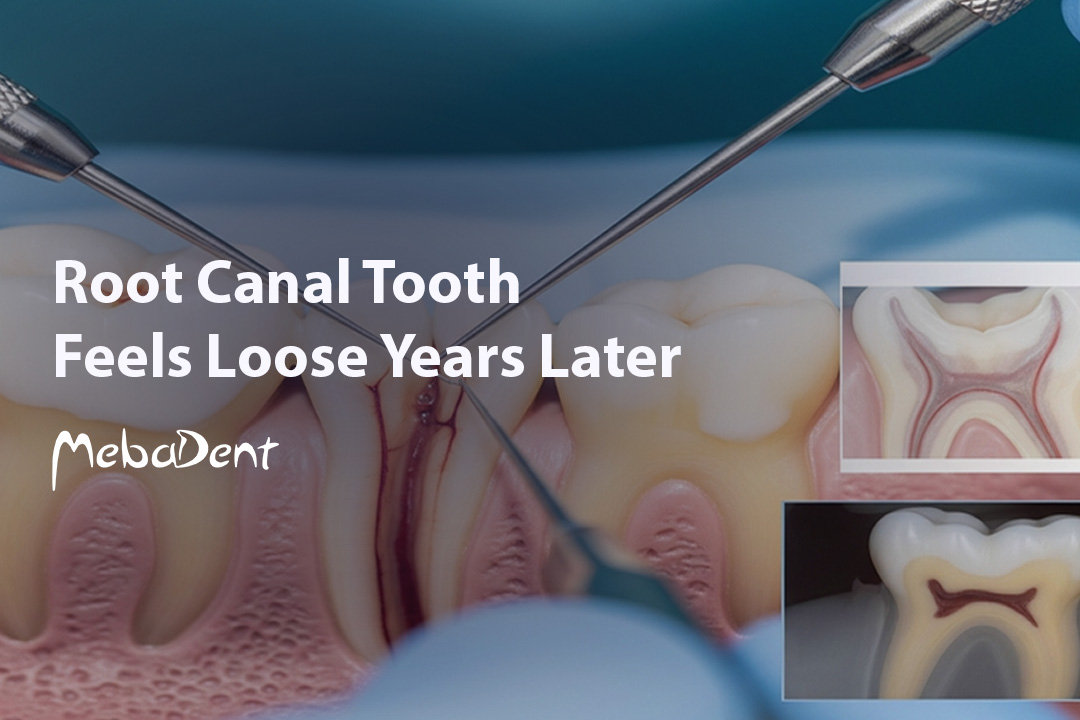
Root canal treatment is a successful treatment method applied to remove the nerve and vascular tissue of the tooth, eliminate infection, and preserve the tooth. However, some patients may experience complaints such as a feeling of looseness, pain, or sensitivity in the treated tooth years later. This situation is an important clinical condition that needs to be carefully evaluated by both patients and dentists.
At Mebadent Dental Clinic, we provide comprehensive services in the diagnosis and treatment of complications after root canal treatment. In this article, we will discuss in detail the causes of problems that occur years after root canal treatment, their symptoms, treatment options, and the experiences of our patients who have encountered this situation.
Why Does a Root Canal Tooth Feel Loose or Hurt Years Later?
A root canal-treated tooth feeling loose or hurting years later may be a sign that the treatment has failed or a new problem has developed. Various mechanisms lie behind this condition.
The long-term success rate of root canal treatment is between 85-95%. Despite this high success rate, treatment may fail years later in some teeth. Failure can occur immediately after treatment or even 5, 10, or 20 years later.
The feeling of looseness may be actual mobility (tooth movement) or a sensation perceived by the patient. Infection at the root tip causes bone erosion and inflammation in the surrounding bone tissue. This creates a feeling in the patient that the tooth is loose or about to come out. Actual mobility is generally seen in cases of advanced bone loss or root fracture.
Pain and sensitivity are not expected in a root canal-treated tooth because the nerve tissue has been removed. However, when the infection at the root tip affects the surrounding tissues, the nerves in the periodontal ligament and bone tissue produce pain signals. This is why a root canal-treated tooth can hurt.
Two Primary Causes of Failure (Infection vs. Fracture)
There are two main causes of root canal treatment failure: re-infection and tooth fracture. Distinguishing between these two conditions is critical for treatment planning because the prognosis and treatment approaches differ.
1. Re-Infection: Bacteria Seeping Back In (The Most Common Cause)
Re-infection is the most common cause of root canal treatment failure. Bacteria that were not completely cleaned during the initial treatment or that leaked in later multiply in the root canal system and cause infection.
The mechanisms of re-infection formation are as follows:
Inadequate root canal cleaning is when some canals are missed during the initial treatment or all canals cannot be completely cleaned. This risk is higher especially in teeth with complex root canal anatomy (extra canals, curved roots, accessory canals).
Inadequate root canal filling creates space for bacteria to survive when the canal filling does not reach the root tip or leaves voids. This condition, called apical leakage, causes the infection to continue.
Coronal leakage is the seepage of bacteria into the canal from the upper part of the tooth. Inadequate filling, broken or leaking restoration, decay formation, or leakage from under the crown can lead to coronal leakage.
Resistant bacteria species – some bacteria species (especially Enterococcus faecalis) are resistant to standard root canal treatment procedures and can remain in low numbers and multiply years later.
Periapical lesion remnants – the infected tissue at the root tip may not have completely healed during the initial treatment and may become active again over time.
2. Tooth Fracture: Internal or Vertical Root Fracture
Tooth fracture, especially vertical root fracture, is the second important cause of root canal treatment failure. Unlike infection, this condition is a serious complication that generally requires tooth extraction.
The reasons why root canal-treated teeth are more prone to fracture are as follows:
Weakening of tooth structure – enlargement of the pulp chamber and root canals during root canal treatment weakens the tooth tissue. Additionally, there is already lost tissue due to previous decay and filling.
Dehydration – root canal-treated teeth become drier and more brittle over time compared to vital teeth. Cutting off the blood circulation in the tooth pulp affects the tooth’s nutrition.
Excessive forces – root canal-treated teeth without crowns are more vulnerable to chewing forces. Teeth clenching or grinding habits increase the risk.
Post (intracanal support) application – in some cases, metal or fiber posts placed in the canal can create a basis for root fracture when used improperly.
The characteristics of vertical root fracture are as follows:
- The fracture line extends vertically along the root.
- Diagnosis is generally difficult; it is not always visible on X-rays.
- Bacterial leakage occurs along the fracture line.
- Localized deep periodontal pocket formation is typical.
- Prognosis is generally poor and requires extraction.
Symptoms of Failed Root Canal Years Later
Failed root canal treatment manifests itself with various symptoms. Being aware of these symptoms is important for early diagnosis and treatment.
Persistent or Returning Pain and Sensitivity
Pain is not expected in a root canal-treated tooth because the nerve tissue has been removed. However, various pain patterns can be seen in failed treatment.
Biting and chewing pain is the most common complaint. Pain is felt when pressing on the tooth or chewing food. This pain results from the infection at the root tip affecting the periodontal ligament.
Spontaneous pain is pain that occurs on its own without any stimulus. It is seen during acute flare-up periods and can be quite severe.
Percussion sensitivity is sensitivity felt when the tooth is tapped or touched. This is a sign of apical periodontitis (root tip inflammation).
Palpation sensitivity is pain or sensitivity felt when pressing on the gum tissue in the root tip area. This indicates that the infection has affected the bone and soft tissues.
Hot and cold sensitivity is normally not expected in a root canal-treated tooth. If present, a missed canal or referred pain from another tooth should be considered.
Intermittent pain attacks – sometimes pain lasts for a few days or weeks, then subsides and starts again. This pattern indicates acute flare-ups of chronic infection.
Root Canal Infection Symptoms (Swelling, Gum Bump, Discharge)
Root canal infection manifests itself with various clinical signs in addition to pain.
Gum swelling occurs when the infection spreads outside the bone and accumulates in soft tissues. Swelling can be localized or spread to the face, reaching serious dimensions.
Fistula (pimple-like bump on the gum) is a channel formation where chronic infection drains. A small bubble, sometimes filled with pus, is seen on the gum. When the bubble bursts, pus drains and temporary relief is achieved, but it fills up again.
The characteristics of a fistula are as follows:
- Usually seen on the gum at the level of the tooth’s root tip.
- Yellow-white pus or blood may come from inside.
- There may be no pain because the infection is draining.
- Causes bad taste and bad breath.
- Does not close on its own without treatment.
Pus discharge – pus coming through the fistula or from around the tooth indicates that the infection is active. Discharge can be continuous or intermittent.
Bad breath – chronic infection and the presence of pus cause a characteristic bad odor.
Regional lymph node swelling – swelling and tenderness of the lymph nodes under the jaw or in the neck may be seen.
Fever and general malaise – systemic symptoms may appear if the infection spreads.
Treatment Options for a Failed Root Canal
Management of failed root canal treatment is determined according to the cause of failure, the condition of the tooth, and patient preferences. The main treatment options are as follows:
1. Root Canal Retreatment (The Primary Choice)
Root canal retreatment (retreatment or re-endodontics) is the first preferred treatment method in failed root canal treatment. In this procedure, the existing canal filling is removed, the canals are re-cleaned and refilled.
The indications for retreatment are as follows:
- Inadequate root canal filling (short filling, voids)
- Presence of missed canals
- Contamination due to coronal leakage
- Persistence or enlargement of the periapical lesion
- Persistence of symptoms
The stages of retreatment are as follows:
- Removal of existing restoration – crown, filling, or post, if present, is safely removed.
- Removal of old canal filling – gutta-percha and canal paste are removed using special instruments, solvents, or ultrasonic devices.
- Reshaping and cleaning of canals – missed canals are found, all canals are cleaned and shaped to the apex.
- Disinfection – irrigation solutions and intracanal medications such as calcium hydroxide are used if necessary.
- Refilling – canals are refilled after being completely cleaned.
- Coronal restoration – appropriate restoration is made to prevent leakage.
The success rate of retreatment is between 75-85%. Success depends on factors such as the severity of infection, root canal anatomy, and the quality of previous treatment.
You can visit our page for detailed information about Root Canal Treatment.
2. Apicoectomy (Surgical Removal of the Root Tip)
Apicoectomy (or root-end resection) is a surgical procedure performed when root canal retreatment is not possible or has failed.
The indications for apicoectomy are as follows:
- Situations where root canal retreatment is technically not possible (non-removable post, broken instrument, excessively curved root)
- Situations where retreatment has failed
- Large periapical lesions
- Anatomical complications at the root tip (delta formation, apical ramifications)
- Need for biopsy
The stages of apicoectomy are as follows:
- Local anesthesia is administered.
- The gum is incised and the bone is exposed. A mucoperiosteal flap is raised to reach the root tip.
- A bone window is opened. The necessary amount of bone tissue is removed to see the root tip.
- The root tip is cut. The last 3 mm of the root is resected at an angle.
- Retrograde filling is performed. The canal is entered from the cut root tip and closed with special filling material (usually MTA or Biodentine).
- The lesion is cleaned. Infected granulation tissue or cyst is curetted.
- The wound is closed. The flap is sutured back in place.
The success rate of apicoectomy is between 85-95%, and this rate is increasing with modern techniques.
When is Extraction the Only Option? (Severe Fracture or Bone Loss)
In some cases, root canal retreatment or apicoectomy is not possible, and tooth extraction remains the only option.
Situations requiring extraction are as follows:
- Vertical root fracture – in the presence of vertical root fracture, saving the tooth is not possible. Continuous bacterial leakage occurs along the fracture line, and treatment fails.
- Advanced bone loss – if a large portion of the bone tissue around the root is lost, the tooth will not have sufficient support.
- Tooth damage beyond restoration – extraction may be necessary if the remaining tooth tissue is insufficient for restoration.
- Multiple treatment failures – extraction is considered if both retreatment and apicoectomy have failed.
- Anatomical obstacles – in some cases, root anatomy or position makes treatment impossible.
- Economic and practical considerations – in some patients, extraction and implant may be a more sensible option than complex treatments.
- Options after extraction are as follows:
- Dental implant is the most ideal solution to replace the missing tooth. It can be placed after the bone heals or simultaneously with extraction in some cases.
- Bridge prosthesis can be considered as an implant alternative, although it requires grinding of adjacent teeth.
- Removable prosthesis is an economical alternative but has disadvantages in terms of comfort and function.
You can visit our page for detailed information about Implant Treatment.
Experiences of Patients Who Had Problems After Root Canal Treatment
Below we share the real experiences of our patients who had problems after root canal treatment and received treatment at our clinic:
“I had root canal treatment 15 years ago, and for the last 6 months, my tooth felt like it was loose and hurt occasionally. When I came to the clinic, I was told there was a large infection at the root tip. The root canal treatment was renewed, and at the check-up 3 months later, everything had returned to normal. I’m very happy that I saved my tooth.”
“7 years after root canal treatment on my back tooth, something like a pimple appeared on my gum. It would sometimes burst, and a bad taste would come. I learned it was a fistula. Retreatment was done, and the fistula closed. I wish I had come earlier.”
“Severe pain started in my root canal-treated tooth, and my face swelled up too. Emergency intervention was performed, the abscess was drained, and antibiotics were given. Then retreatment was attempted, but it turned out there was a root fracture. Unfortunately, I had to have the tooth extracted and got an implant in its place.”
“My 10-year-old root canal-treated tooth had mild pain and a feeling of pressure. A lesion was seen at the root tip on X-ray. Retreatment was technically difficult because there was a metal post inside. Apicoectomy was performed, and it was very successful. No problems for 2 years now.”
“My root canal-treated tooth hurt when I bit down and felt like it was loose occasionally. No serious problem was seen in the examination, but we took a CBCT, and a vertical fracture was detected. Apparently, it wasn’t visible on regular X-rays. I had to have the tooth extracted; I was very sad, but there was no other option.”
“Problems started 3 years after root canal treatment done at another clinic. When evaluated here, it was seen that one of the canals had been missed. The missed canal was found and treated in the retreatment. It’s been 4 years now, and I haven’t had any problems.”
Conclusion: Don’t Delay Treatment for Persistent Pain or Looseness
A feeling of looseness, pain, or sensitivity that occurs years later in a root canal-treated tooth may be a sign that the treatment has failed or a new problem has developed. These symptoms should not be ignored, and professional evaluation should be obtained as soon as possible.
At Mebadent Dental Clinic, we provide comprehensive services in the diagnosis and treatment of failed root canal treatments. With modern imaging techniques and treatment methods, we aim for the highest possible success rate.
The symptoms to watch for in a root canal-treated tooth are as follows:
- Pain during biting or chewing
- Feeling of looseness or elongation in the tooth
- Pimple-like bump on the gum (fistula)
- Swelling or tenderness in the area
- Bad taste or bad breath
- Spontaneous pain attacks
If you experience any of these symptoms, we recommend that you make an Appointment for evaluation without delay. Early diagnosis and treatment significantly increase the chance of saving your tooth.
Frequently Asked Questions
Can a root canal-treated tooth really become loose?
Yes, a root canal-treated tooth can really become loose. Chronic infection at the root tip erodes the surrounding bone tissue and weakens the tooth’s support. Additionally, vertical root fracture can also cause actual tooth mobility. However, sometimes the patient may perceive the pressure sensation due to infection as looseness.
Can root canal treatment be redone?
Yes, failed root canal treatments can be redone in most cases. In retreatment, the existing filling is removed, the canals are re-cleaned and refilled. The success rate is between 75-85%. However, some technical difficulties (non-removable post, broken instrument) may prevent retreatment.
How successful is apicoectomy?
The success rate of apicoectomy performed with modern techniques is between 85-95%. The use of surgical microscopes, ultrasonic devices, and biocompatible filling materials (MTA, Biodentine) has increased the success rate. However, not every case is the same, and success varies according to the size of the lesion and the condition of the tooth.
How is root fracture diagnosed?
Diagnosis of vertical root fracture can be difficult. It is not always visible on regular X-rays. CBCT (cone beam computed tomography) is very valuable for diagnosis. Clinical findings include localized deep periodontal pocket, fistula, and biting pain. Definitive diagnosis may sometimes require surgical exploration.
When should a root canal-treated tooth be extracted?
Extraction may be necessary in cases of vertical root fracture, advanced bone loss, tooth damage beyond restoration, or multiple treatment failures. The extraction decision should be made after detailed evaluation. If there is a chance of saving the tooth, conservative treatments should be tried first.
How is the space closed after extraction?
Options for the space after extraction include dental implant, bridge prosthesis, or removable prosthesis. Dental implant is the most ideal solution in terms of function and aesthetics. Treatment choice is determined according to the patient’s general health condition, bone structure, expectations, and budget.