
 TR
TR
 EN
EN

- MebaDent
Dental Bridge vs Implant: Cost, Durability & How to Choose (2026)
Dental Bridge vs Implant: Cost, Durability & How to Choose (2026)
Losing a tooth raises an immediate question: bridge or implant? Both options restore function and appearance, but they differ significantly in procedure, longevity, cost, and long-term impact on surrounding teeth. The right choice depends on clinical factors, budget, and personal priorities.
This guide compares dental bridges and implants across every criterion that matters — from durability and bone preservation to cost in the UK and Turkey — to help patients make an informed decision.
What Is a Dental Bridge?
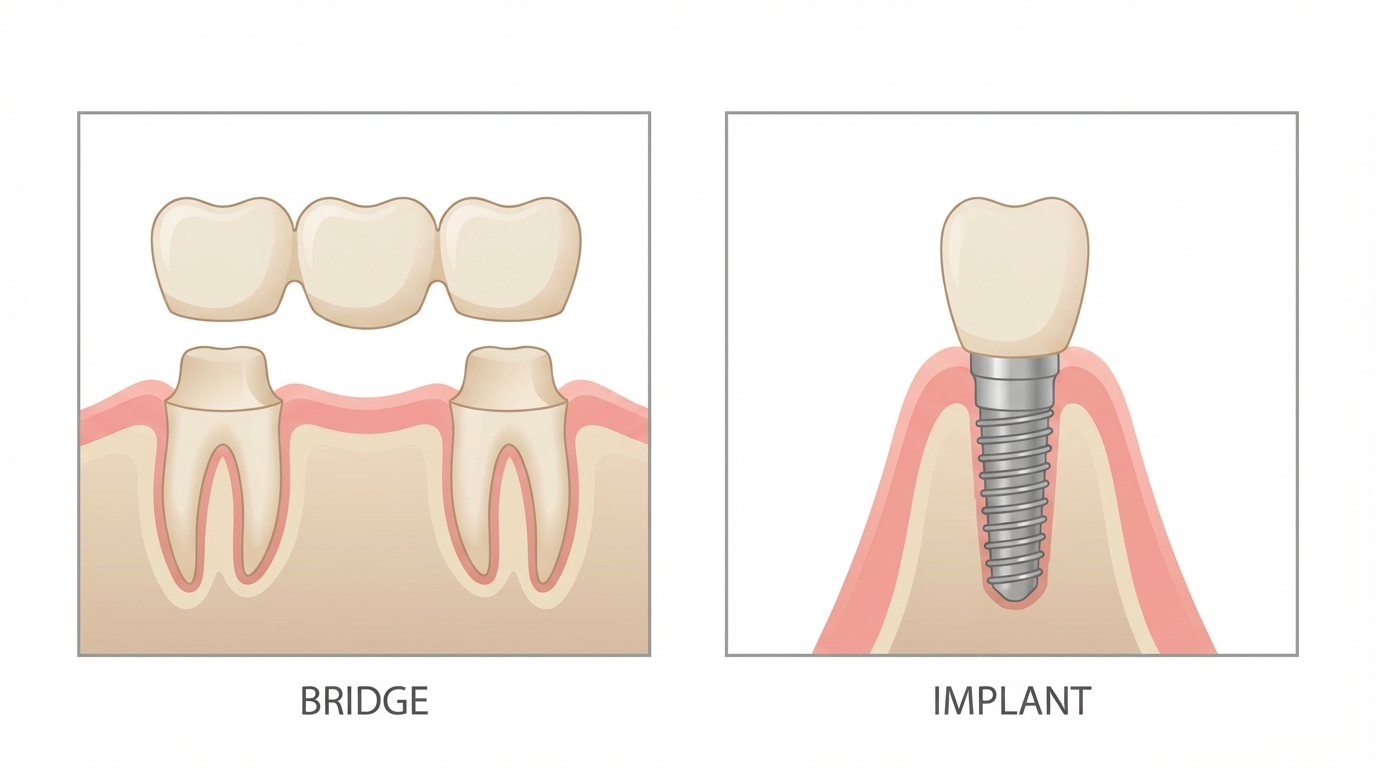
A dental bridge is a fixed prosthetic that replaces one or more missing teeth by anchoring to the adjacent natural teeth (called abutments). The false tooth (pontic) is fused between two crowns that are cemented onto the neighbouring teeth. The result is a seamless restoration that looks and functions like natural teeth.
There are several types of bridges. A traditional bridge requires crowning the teeth on both sides of the gap. A cantilever bridge anchors to one adjacent tooth only — used when teeth exist on only one side. A Maryland (resin-bonded) bridge uses a metal or porcelain framework bonded to the back of adjacent teeth with minimal preparation, making it less invasive but also less durable for high-stress areas.
What Is a Dental Implant?
A dental implant is a titanium post surgically placed into the jawbone to replace the root of a missing tooth. After a healing period of 3-6 months (during which the implant integrates with the bone in a process called osseointegration), an abutment and crown are attached on top. The result is a standalone restoration that does not depend on neighbouring teeth for support.
Implants consist of three components: the fixture (titanium screw in the bone), the abutment (connector piece), and the crown (the visible tooth). Modern implant systems from brands such as Straumann, Nobel Biocare, and Osstem have documented long-term success rates exceeding 95%.
Dental Bridge vs Implant: Side-by-Side Comparison
| Criterion | Dental Bridge | Dental Implant |
|---|---|---|
| Lifespan | 5-15 years | 15-25+ years (fixture: lifetime) |
| Procedure Time | 2-3 weeks | 3-6 months (with healing) |
| Surgery Required | No | Yes (minor oral surgery) |
| Adjacent Teeth Affected | Yes — requires crowning | No — standalone |
| Bone Preservation | No — bone loss continues | Yes — stimulates bone |
| Cleaning | Requires floss threaders | Standard brushing and flossing |
| Aesthetics | Good | Excellent |
| Cost (UK) | £700-£1,500 | £2,000-£3,500 |
| Cost (Turkey) | £200-£500 | £400-£900 |
Prices are for informational purposes only. For exact pricing, please consult your dentist or clinic.
When Is a Dental Bridge the Better Option?
A bridge may be the more suitable choice in the following scenarios:
- The adjacent teeth already have large fillings or crowns and would benefit from being crowned regardless
- The patient cannot undergo surgery due to medical conditions (uncontrolled diabetes, certain blood disorders, recent radiotherapy to the jaw)
- Insufficient bone volume exists and the patient prefers to avoid bone grafting procedures
- A faster solution is needed — bridges can be completed in 2-3 weeks versus months for implants
- Budget is a primary constraint and the long-term cost difference is less of a concern
Bridges have been used successfully in dentistry for decades and remain a reliable, well-documented treatment option.
When Is a Dental Implant the Better Option?
An implant is generally the preferred option when:
- The adjacent teeth are healthy and structurally sound — crowning them for a bridge would sacrifice healthy tooth structure unnecessarily
- Bone preservation matters — implants are the only tooth replacement option that stimulates the jawbone and prevents the bone loss that occurs after tooth extraction
- Long-term value is prioritised — although the upfront cost is higher, an implant's longer lifespan often makes it more cost-effective over 20-30 years
- The missing tooth is in a highly visible area where the best possible aesthetics are desired
- Multiple teeth are missing — implant-supported bridges avoid the need to rely on natural teeth as anchors
Cost Comparison: UK vs Turkey
| Treatment | UK Price Range | Turkey Price Range | Savings |
|---|---|---|---|
| 3-Unit Bridge (Zirconia) | £1,500-£3,000 | £400-£900 | 60-70% |
| Single Implant + Crown | £2,000-£3,500 | £400-£900 | 70-75% |
| All-on-4 (per arch) | £10,000-£15,000 | £3,000-£5,500 | 60-65% |
The price difference is largely driven by lower operational costs in Turkey rather than lower quality of materials or expertise. Many Turkish clinics use the same implant brands and laboratory materials as UK clinics. Patients considering treatment abroad should factor in travel and accommodation costs, though all-inclusive packages offered by many clinics often make the total cost still significantly lower than UK-only treatment.
Prices are for informational purposes only. For exact pricing, please consult your dentist or clinic.
Frequently Asked Questions
Can a dental bridge last as long as an implant?
In most cases, no. A well-maintained bridge typically lasts 5-15 years before it needs replacement. An implant fixture can last a lifetime with proper care, though the crown on top may need replacing after 10-15 years. The gap in longevity means that over a 30-year period, a patient may need 2-3 bridges versus one implant with one crown replacement.
Is getting a dental implant painful?
The procedure is performed under local anaesthesia and most patients report less discomfort than expected — often comparing it to a tooth extraction. Post-operative pain is typically mild and managed with standard painkillers for 2-3 days. Advances in guided implant surgery have further reduced invasiveness and recovery time.
Can a bridge be replaced with an implant later?
Yes, in most cases. If a bridge fails or the patient decides they want a longer-lasting solution, it can be removed and replaced with an implant. However, bone loss that occurred under the bridge may require a bone graft before the implant can be placed, adding time and cost. This is one reason some clinicians prefer implants as a first-line option — they preserve bone from the outset.
How many teeth can a dental bridge replace?
A traditional bridge typically replaces 1-3 missing teeth in a row. Longer-span bridges (4+ teeth) are possible but become less predictable as the span increases, placing greater stress on the anchor teeth. For replacing multiple consecutive missing teeth, implant-supported bridges or removable prosthetics are generally more reliable options.
Which option is better for front teeth?
Both options can deliver excellent results for front teeth. Implants offer a slight aesthetic advantage because they emerge from the gum like a natural tooth and do not require modifying adjacent teeth. A well-made bridge, however, can also look indistinguishable from natural teeth. The decision often comes down to the health of the neighbouring teeth: if they are intact, an implant preserves them; if they already need crowns, a bridge makes practical sense.
Conclusion
Neither option is universally "better" — the right choice depends on individual clinical circumstances, priorities, and budget. Bridges offer a faster, non-surgical solution at a lower upfront cost. Implants provide superior longevity, bone preservation, and independence from adjacent teeth at a higher initial investment.
A thorough consultation with a qualified dentist who presents both options — along with their specific pros, cons, and costs — is the best starting point for making this decision.
At Mebadent Dental Clinic in Istanbul, both dental bridges and implants are performed by specialist prosthodontists and implantologists using premium materials. Each patient receives a personalised treatment plan with transparent pricing. For a free consultation, contact the clinic directly.